
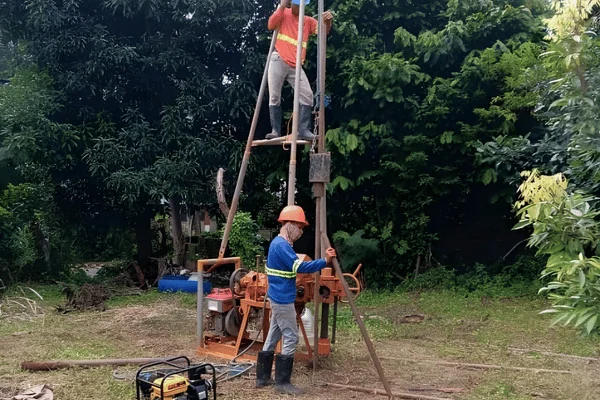
Soil conditions determine how safely and effectively any structure performs over time. Every building, road, bridge, or foundation relies on accurate understanding of subsurface behavior before construction begins. The Standard Penetration Test plays a central role in geotechnical soil investigation by providing measurable field data that engineers depend on for foundation design and risk assessment.
The Standard Penetration Test is widely applied in soil exploration programs because it helps identify soil strength, density, and variation across depth levels. Inch-On Materials Testing Laboratory performs the Standard Penetration Test as part of its geotechnical services to support safe and code-compliant construction projects through accurate field and laboratory data.
What is the Standard Penetration Test (SPT)?
The Standard Penetration Test is a field testing method used during geotechnical soil investigation to evaluate the resistance of soil layers. This test is performed inside a borehole and measures how much effort is required to drive a sampler into the ground at specific depths.
The Standard Penetration Test produces a value known as the N-value, which represents the number of hammer blows needed to penetrate soil under standardized conditions. This value helps engineers classify soil type and estimate its strength and density.
The Standard Penetration Test is commonly used in foundation design studies because it provides practical, repeatable, and widely accepted data for interpreting subsurface conditions.
How the Standard Penetration Test Works
The Standard Penetration Test is conducted during borehole drilling as part of a geotechnical investigation program. A drilling rig creates a borehole to reach target depths where soil evaluation is required.
Once the borehole reaches the desired depth, a split-spoon sampler is placed at the bottom. A standard weight hammer is then dropped repeatedly from a fixed height to drive the sampler into the soil. The Standard Penetration Test records the number of hammer blows needed to achieve specific penetration intervals.
The process typically includes:
- Drilling a borehole to the required depth
- Positioning the split-spoon sampler at the test layer
- Driving the sampler using a standard hammer system
- Recording blow counts for penetration resistance
- Extracting soil samples for visual and laboratory review
The resulting Standard Penetration Test data reflects soil resistance at different depths, helping engineers understand how soil conditions change vertically across the site.
Key Data Generated from the Standard Penetration Test
The Standard Penetration Test produces essential data used in geotechnical analysis and foundation design. One of the most important outputs is the N-value, which indicates soil resistance to penetration.
Higher N-values from the Standard Penetration Test typically suggest denser or stronger soil, while lower values indicate softer or weaker layers. This information allows engineers to classify soil conditions more accurately.
Other important outputs from the Standard Penetration Test include:
- Soil stratification profiles showing different soil layers
- Identification of soft clay zones or loose sandy deposits
- Indications of potential groundwater influence on soil behavior
- Support data for estimating bearing capacity
- Reference values for liquefaction assessment in sandy soils
The Standard Penetration Test also supports correlation with laboratory testing results, improving overall confidence in soil interpretation.
Why the Standard Penetration Test Matters for Construction Projects
The Standard Penetration Test plays a critical role in ensuring safe and cost-effective foundation design. Construction projects depend on accurate soil data to avoid structural problems that may arise from unknown ground conditions.
One major benefit of the Standard Penetration Test is its ability to reduce uncertainty during design planning. Engineers can match foundation systems to actual soil strength instead of relying on assumptions.
The Standard Penetration Test also helps reduce construction risks such as uneven settlement, tilting structures, and foundation cracking. These issues often occur when soil conditions are not properly evaluated before construction begins.
Key benefits include:
- Better foundation design based on real soil resistance data
- Reduced risk of settlement and structural deformation
- Improved cost control through accurate soil profiling
- Early identification of weak or unstable soil zones
- Stronger decision-making for deep or shallow foundation systems
The Standard Penetration Test remains one of the most trusted field methods for guiding safe structural development across various construction types.
Standard Penetration Test Compliance and Engineering Standards
The Standard Penetration Test follows internationally recognized procedures to ensure accuracy and consistency of results. ASTM standards define the equipment, method, and interpretation process used during testing.
AASHTO standards also support the use of the Standard Penetration Test in transportation and infrastructure projects, particularly for roads and bridges where soil stability is essential.
Local construction requirements often reference DPWH-BRS guidelines for geotechnical investigations. The Standard Penetration Test is commonly required as part of soil investigation reports submitted for building permits and structural approval.
Compliance with these standards ensures that Standard Penetration Test results are accepted by engineers, regulators, and project stakeholders.
Role of the Standard Penetration Test in Geotechnical Soil Investigation
The Standard Penetration Test forms a core part of geotechnical soil investigation programs. It is rarely performed alone and is usually combined with drilling logs, sampling, and laboratory testing to produce a complete soil profile.
During a geotechnical investigation, the Standard Penetration Test provides field resistance data, while laboratory tests provide detailed material properties such as moisture content, grain size distribution, and plasticity.
Together, these results help engineers:
- Determine soil bearing capacity
- Design foundation systems suitable for site conditions
- Assess settlement behavior over time
- Identify zones requiring soil improvement or replacement
The Standard Penetration Test acts as a bridge between field observation and engineering design requirements.
Field Testing Expertise at Inch-On Materials Testing Laboratory
Inch-On Materials Testing Laboratory performs the Standard Penetration Test as part of its accredited geotechnical services. Established in 2018, the laboratory supports construction quality assurance through reliable field and laboratory testing.
The Standard Penetration Test is conducted using calibrated equipment and trained personnel to ensure accurate and consistent results. Field teams carry out on-site soil investigation activities that include borehole drilling, sampling, and penetration testing.
Services related to the Standard Penetration Test include:
- On-site soil investigation and borehole drilling
- Field measurement of soil resistance using Standard Penetration Test procedures
- Documentation of subsurface soil profiles
- Technical reporting for engineering and permit requirements
The laboratory operates under DPWH-BRS accreditation and follows ASTM and AASHTO standards, ensuring that every Standard Penetration Test result meets recognized technical requirements for construction projects.
Laboratory Testing Support for Standard Penetration Test Results
The Standard Penetration Test provides field-based soil resistance data, but laboratory testing adds deeper insight into soil properties. Inch-On Materials Testing Laboratory supports Standard Penetration Test results with controlled testing of soil samples collected during field investigation.
Laboratory analysis may include:
- Moisture content testing
- Grain size distribution analysis
- Atterberg limits for soil plasticity
- Compaction and density evaluation
These tests help validate and interpret Standard Penetration Test findings. When field and laboratory results are combined, engineers gain a clearer understanding of soil behavior under load conditions.
This combined approach strengthens geotechnical reports and improves confidence in foundation design decisions.
Common Applications of the Standard Penetration Test
The Standard Penetration Test is widely used across different types of construction projects due to its reliability and practicality.
Common applications include:
- Residential building foundations
- High-rise and commercial structures
- Road and highway construction
- Bridge and bridge approach foundations
- Industrial facility development
- Utility and infrastructure projects
The Standard Penetration Test is especially important for projects that require deep foundations or are located on variable soil conditions.
Risks of Skipping the Standard Penetration Test
Skipping the Standard Penetration Test can expose construction projects to serious risks. Without proper soil data, engineers may design foundations based on assumptions rather than actual ground conditions.
Possible consequences include:
- Uneven settlement of structures
- Foundation failure due to weak soil layers
- Costly redesign or repair work during construction
- Delays in permit approval due to missing geotechnical data
- Reduced structural safety and long-term performance
The Standard Penetration Test reduces these risks by providing measurable and reliable soil resistance data before construction begins.
Reliable Foundations Start with the Standard Penetration Test
The Standard Penetration Test remains one of the most important methods in geotechnical soil investigation. It provides essential data that supports safe foundation design, accurate soil classification, and informed engineering decisions.
Inch-On Materials Testing Laboratory delivers Standard Penetration Test services supported by accredited procedures, calibrated equipment, and compliance with recognized engineering standards. Each Standard Penetration Test conducted contributes to safer, more reliable, and better-planned construction projects.
Frequently Asked Questions (FAQ)
What is the Standard Penetration Test used for?
The Standard Penetration Test is used to measure soil resistance and determine soil strength and density for foundation design and geotechnical analysis.
Why is the Standard Penetration Test important in construction?
The Standard Penetration Test helps engineers design safe foundations by providing real data on subsurface soil conditions, reducing risks of settlement and structural failure.
What does the N-value in the Standard Penetration Test mean?
The N-value represents the number of hammer blows needed to drive a sampler into the soil. It indicates soil density and strength, which are key inputs for design.
Is the Standard Penetration Test required for building permits?
Many construction projects require the Standard Penetration Test as part of geotechnical reports submitted for DPWH-BRS and local building permit compliance.
How deep is the Standard Penetration Test conducted?
The depth depends on project requirements, but the Standard Penetration Test is usually performed at multiple depths within boreholes to capture soil variation across layers.
Can the Standard Penetration Test identify weak soil?
Yes, the Standard Penetration Test can detect weak or loose soil layers by showing low resistance values, helping engineers plan appropriate foundation solutions.