Construction quality depends on more than the visible finish of a building, bridge, foundation, or masonry system. Materials hidden beneath surfaces can play a major role in structural performance. Grout is one such material. Proper grout placement, filling, consolidation, and performance can be important for masonry, structural connections, foundations, anchors, and other specialized construction applications.
Grout integrity testing Philippines services can help engineers, contractors, developers, and project owners obtain technical information about grout quality and installed conditions. Proper evaluation can help identify possible defects, support quality control, and provide documentation for engineering review.
A suitable testing program should always match the grout application, project specifications, design requirements, and applicable testing standards. Professional materials testing laboratories can help project teams select appropriate evaluation procedures and interpret results within the defined testing scope.
Inch-On Materials Testing Laboratory is a DPWH-BRS accredited Engineering and Construction Laboratory established in November 2018. The laboratory provides independent testing of soil and construction materials, along with field testing of soil, concrete, and foundation piles using specialized equipment. Its documented services include laboratory testing, concrete hollow block testing, ultrasonic testing, pile integrity testing, and other construction-related evaluations.
What Is Grout Integrity Testing?
Grout integrity testing refers to the evaluation of grout quality, condition, continuity, or specified performance characteristics using a testing method appropriate for the particular construction application.
Grout may be used to fill spaces, provide bonding, transfer loads, support reinforcement, strengthen masonry assemblies, or connect construction components. Since much of the grout can become concealed after installation, visual inspection alone may not provide enough information about its condition.
A grout integrity testing Philippines program may therefore form part of a wider construction quality-control process. Depending on the project, evaluation may focus on grout material properties, installed condition, possible voids, discontinuities, cracking, inadequate filling, or other concerns identified by the engineer.
Testing should not be treated as a single universal procedure. Different grout applications require different evaluation approaches. Project specifications, drawings, grout type, construction method, structural purpose, and applicable standards should guide the selection of the appropriate test.
Why Is Grout Integrity Testing Important for Philippine Construction Projects?
Construction projects across the Philippines range from residential developments and commercial buildings to industrial facilities, infrastructure, foundations, and specialized engineering structures. Each project has its own material requirements and quality-control procedures.
Grout integrity testing Philippines can provide useful technical information when grout contributes to the intended performance of a construction element.
Helps Verify Material Quality
Grout must meet the requirements established for its intended application. Testing can provide measurable information about specified properties and help project teams compare results with project requirements.
This type of verification can support quality-control personnel, contractors, engineers, consultants, and developers during construction.
Supports Structural Quality Control
Quality control works best when material verification occurs alongside proper installation procedures, inspection, documentation, and engineering review.
Grout integrity testing can form part of this process by supplying objective test data that complements site inspections and construction records.
Helps Identify Potential Defects
Poor mixing, inadequate placement, incomplete filling, segregation, cracking, or void formation may affect a grouted component depending on its purpose and design.
Appropriate testing or investigative procedures can help identify areas that require further engineering review.
Provides Technical Documentation
Construction projects often require documented evidence of material quality. Properly prepared laboratory or field reports can provide engineers and project teams with test results, sample details, locations, dates, procedures, and other relevant information.
Such documentation can support project records and quality-control decisions.
Common Applications That May Require Grout Integrity Evaluation
Grout serves many purposes across construction. The appropriate evaluation method depends on the actual application and project requirements.
Structural and Masonry Construction
Grout may be associated with reinforced masonry, concrete masonry units, structural walls, and other masonry systems.
A grout evaluation program can be coordinated with Concrete Hollow Block (CHB) testing and other masonry material assessments when required by the project.
Inch-On lists Concrete Hollow Block Testing among its laboratory services, providing construction teams with access to material testing alongside other laboratory evaluations.
Foundation-Related Construction
Some construction systems use grout as part of foundation or ground-related work. The importance of grout may vary according to the design and installation method.
Projects involving foundation elements can benefit from a coordinated testing strategy covering relevant soil, concrete, pile, and construction-material requirements.
Inch-On provides field testing services that include pile integrity and dynamic testing, Crosshole Sonic Logging, and geotechnical soil investigation.
Anchors and Structural Connections
Grout may serve a specific purpose around anchors, reinforcement, connections, or other structural components. Where grout contributes to load transfer or bonding, verification can become an important part of construction quality control.
The testing approach should be selected according to the engineering design and applicable specification rather than applying one method to every type of grouted connection.
Infrastructure and Industrial Projects
Large infrastructure and industrial projects often involve several construction materials and testing requirements. Grout evaluation can form part of a broader quality-control program covering concrete, aggregates, soil, steel, masonry units, foundations, and other materials.
A laboratory with both field and laboratory capabilities can help project teams coordinate multiple testing requirements through a more organized workflow.
How Does Grout Integrity Testing Work?
There is no single procedure that applies to every grout installation. A professional grout integrity testing Philippines program should begin with the project requirements.
Step 1: Review Project Requirements
The laboratory or testing team should review relevant drawings, specifications, grout information, installation details, acceptance criteria, and requested testing standards.
This step helps establish what needs to be evaluated and which test method is appropriate.
Step 2: Determine the Testing Scope
The testing scope may include material sampling, laboratory evaluation, field investigation, non-destructive evaluation, or another method specified by the engineer.
The actual scope should reflect the purpose of the grout and the concern being investigated.
Step 3: Collect Samples or Conduct Field Evaluation
Where laboratory testing is required, samples should be collected and identified according to the applicable project procedure.
For existing or installed construction, field evaluation may be appropriate where a non-destructive or investigative technique is specified.
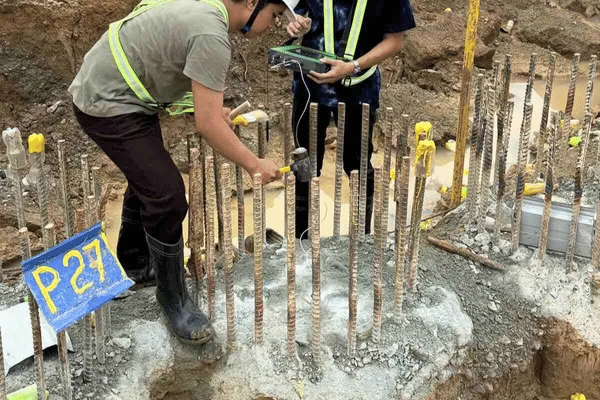
Inch-On provides field testing directly at project sites for soil, concrete, and foundation piles. Its ultrasonic testing service can evaluate concrete uniformity and identify internal conditions such as voids and cracks, while Crosshole Sonic Logging is available for specified foundation applications.
Step 4: Perform the Appropriate Test
Testing should follow the applicable standard and the scope established by the project engineer or specification.
The objective may involve measuring material properties, evaluating uniformity, locating possible discontinuities, or investigating a suspected problem.
Step 5: Evaluate the Results
Results should be compared against the applicable project requirements, specifications, and acceptance criteria.
A laboratory report does not replace engineering judgment. Results should be reviewed by the responsible engineer or qualified project professional when structural decisions are required.
Step 6: Prepare Technical Documentation
A clear report should identify the tested material or location, applicable method, relevant observations, measured results, and other information required by the project.
Good documentation helps maintain a traceable record of construction quality.
Grout Integrity Testing and ASTM Standards
Recognized testing standards help establish consistent procedures for evaluating construction materials. Inch-On states that its laboratory follows ASTM and AASHTO testing standards and operates under DPWH-BRS accreditation.
The specific standard used for a grout evaluation depends on the material, application, and test objective. Project specifications may also identify additional requirements.
It is important not to apply a concrete or masonry-unit standard automatically to every grout application. Each standard has a defined purpose and scope.
ASTM-Based Construction Material Testing
Inch-On’s documented concrete and masonry-related capabilities include testing associated with concrete and Concrete Hollow Blocks. Its broader laboratory services cover aggregates, asphalt, soil, reinforced steel bars/products, and CHB testing.
For example, ASTM C39, ASTM C78, and ASTM C140 relate to specific concrete or masonry testing applications. These standards should be cited only when they match the material and test being performed.
This distinction is important for anyone searching for grout integrity testing Philippines, because grout evaluation should be based on the actual application rather than simply selecting a familiar concrete testing standard.
Grout Integrity Testing vs. Concrete Testing
Grout testing and concrete testing can support the same overall construction quality-control program, but they are not necessarily interchangeable.
| Testing Area | Primary Purpose | Typical Focus |
|---|---|---|
| Grout integrity testing | Evaluate grout condition or specified performance | Continuity, filling, defects, material properties, or other defined indicators |
| Concrete testing | Evaluate concrete properties | Strength and specified physical performance |
| CHB testing | Evaluate masonry units | Strength and physical properties |
| Field testing | Evaluate installed or site conditions | Actual project-site conditions |
| Laboratory testing | Evaluate construction materials under controlled conditions | Standardized material properties |
Understanding these distinctions helps project teams select the correct testing procedure.
A grout integrity testing Philippines request should therefore include enough project information for the laboratory to understand the grout type, intended purpose, installation method, and required evaluation.
Field Testing and Laboratory Testing for Construction Quality
Field and laboratory testing provide different types of information and can complement each other.
Field Testing
Field testing evaluates conditions directly at a project site. This can be valuable when engineers need information about actual installed construction.
Inch-On’s field testing services include Field Density Testing, Rebound Hammer Testing and Rebar Scanning, Pile Integrity and Dynamic Testing, Crosshole Sonic Logging, Standard Penetration Testing, geotechnical soil investigation, and Ultrasonic Testing.
Its Ultrasonic Testing service can assess concrete uniformity and investigate internal voids and cracks without relying solely on surface inspection.
Laboratory Testing
Laboratory testing provides controlled evaluation of soil and construction materials using specialized apparatus and standardized procedures.
Inch-On lists laboratory testing for coarse aggregates, fine aggregates, asphalt, soil, reinforced steel bar/products, and Concrete Hollow Blocks.
When a project requires grout integrity testing Philippines, laboratory services may be coordinated with field evaluation where the project scope calls for both.
How Inch-On Materials Testing Laboratory Supports Construction Projects
Selecting a qualified testing laboratory is an important part of construction quality management.
DPWH-BRS Accreditation
Inch-On Materials Testing Laboratory is accredited by the Department of Public Works and Highways – Bureau of Research and Standards. The company describes its accreditation as part of its commitment to meeting national requirements for engineering and construction testing.
For project teams searching for grout integrity testing Philippines, laboratory accreditation can be one factor to review when evaluating testing providers.
Established Engineering and Construction Laboratory
Established in November 2018, Inch-On focuses on independent verification of soil and construction-material quality. The laboratory also conducts field testing of soil, concrete, and foundation piles.
ASTM and AASHTO Standards
Inch-On states that its testing services follow ASTM and AASHTO standards. Standardized procedures help provide consistent testing and technical documentation.
Specialized Field Equipment
Construction conditions cannot always be evaluated through laboratory samples alone. Field testing can provide information about installed materials and actual project conditions.
Inch-On’s documented field capabilities include concrete evaluation, pile testing, ultrasonic testing, and geotechnical investigation.
Technical Reporting
Testing is most useful when results are presented clearly. Inch-On states that it provides transparent reporting and realistic timelines for project teams.
What Can Affect Grout Integrity?
Several factors may influence grout quality or installed performance. The exact significance of each factor depends on the grout application.
Grout Mix Design
Mix proportions should follow the approved design and project requirements. Material selection and proportions can affect the resulting properties of the grout.
Mixing Practices
Improper mixing can contribute to inconsistent material properties. Proper batching, mixing time, and material handling should follow the specified procedure.
Placement Conditions
Grout placement requires suitable preparation and installation practices. Access, temperature, surface condition, placement sequence, and other site conditions may affect the finished result.
Consolidation and Filling
Incomplete filling or poor consolidation may create voids or weak areas. Where grout serves a structural or bonding function, such conditions may require investigation.
Curing and Protection
Proper curing and protection can influence material development and performance. Project specifications should establish the required curing procedure.
When Should a Project Consider Grout Integrity Testing?
A project may consider grout evaluation at various stages, depending on its design and quality-control plan.
Potential situations include:
- New structural construction
- Reinforced masonry projects
- Foundation-related construction
- Grouted structural connections
- Anchor installations
- Quality-control checkpoints
- Suspected grout defects
- Unexpected material test results
- Investigation of existing construction
- Major infrastructure projects
- Industrial construction
- Remediation or repair projects
For each situation, the responsible engineer should determine the appropriate testing scope.
A grout integrity testing Philippines service should therefore begin with a discussion of the project requirements rather than an assumption that one test applies to every situation.
Benefits of Professional Grout Testing Services in the Philippines
Reliable Technical Data
Professional testing provides measurable information that can help project teams assess construction quality.
Better Quality Control
Testing can complement visual inspections, construction records, material approvals, and site supervision.
Early Identification of Concerns
Potential material or installation concerns can be investigated before additional construction work makes evaluation more difficult.
Better Project Documentation
Formal reports create useful records for engineering review and construction quality documentation.
Support for Engineers and Contractors
Independent testing can provide objective data that engineers, contractors, developers, and project owners can consider alongside their own inspections and technical assessments.
How to Choose a Grout Integrity Testing Laboratory in the Philippines
Choosing a testing provider requires more than searching for a company offering a specific keyword.
Check Accreditation
Review the laboratory’s relevant accreditation and credentials. Inch-On is DPWH-BRS accredited according to its published company information.
Review Testing Standards
Ask which ASTM, AASHTO, project-specific, or other applicable standards will govern the requested evaluation.
Examine Testing Capabilities
A laboratory offering both field and laboratory testing may be useful for projects with several testing requirements.
Ask About Technical Reports
Confirm what information will appear on the final report and whether the format meets project documentation requirements.
Consider Construction Material Experience
A laboratory with experience covering concrete, CHB, soil, aggregates, steel, foundations, and other construction materials can support broader quality-control programs.
Why Independent Materials Testing Matters
Independent testing provides project teams with objective measurements that can complement contractor inspections and engineering assessments.
For construction projects, independent materials testing can help verify whether selected materials and installed construction meet specified requirements.
Inch-On describes its role as an independent testing laboratory dedicated to verifying soil and construction-material quality. Its services cover both laboratory evaluation and field-based testing.
For a grout integrity testing Philippines project, this independent role can help establish a documented testing process that supports engineering review.
Takeaway
Grout integrity testing Philippines can provide valuable technical information for construction projects where grout contributes to structural performance, bonding, filling, anchorage, masonry, foundation work, or specialized connections.
The correct testing approach depends on the grout application, project specifications, design requirements, installation conditions, and applicable standards. Rather than treating grout testing as a single universal procedure, project teams should work with qualified testing professionals to establish a testing scope that matches the actual engineering requirement.
Inch-On Materials Testing Laboratory offers independent construction materials testing and field evaluation services. The laboratory was established in November 2018 and is DPWH-BRS accredited. Its published services cover laboratory testing, Concrete Hollow Block testing, concrete-related field evaluation, pile integrity testing, ultrasonic testing, geotechnical investigation, and other construction quality-control services.
For contractors, developers, structural engineers, project managers, and construction professionals searching for Grout integrity testing Philippines, a properly planned testing program can provide useful data for quality control, engineering review, and project documentation.
Contact Inch-On Materials Testing Laboratory to discuss your project requirements, testing scope, sampling needs, applicable standards, field conditions, and technical reporting requirements.
Frequently Asked Questions About Grout Integrity Testing Philippines
What is grout integrity testing Philippines?
Grout integrity testing Philippines refers to testing or evaluation performed to assess grout quality, condition, continuity, specified material properties, or potential defects according to the requirements of a particular construction project.
Why is grout integrity testing important?
Grout can serve important functions within masonry, structural connections, foundations, anchors, and other construction systems. Appropriate testing can provide technical information about grout performance or installed condition and help support construction quality control.
What standards are used for grout testing?
The applicable standard depends on the grout type, application, testing objective, project specification, and engineering requirements. ASTM and AASHTO standards may apply to particular construction-material tests, but the correct standard should always match the actual test scope.
Can grout testing be performed at a construction site?
Some evaluation procedures can be performed at project sites, while other tests require laboratory conditions. The appropriate approach depends on the construction element and test objective.
Inch-On provides field testing services covering soil, concrete, foundation piles, ultrasonic testing, and other field-based evaluations.
What is the difference between grout testing and concrete testing?
Grout testing focuses on the requirements of grout material or installed grout, while concrete testing evaluates specific properties of concrete. Both can form part of a broader construction quality-control program, but the applicable test method and standard may differ.
Does Inch-On Materials Testing Laboratory provide construction material testing?
Yes. Inch-On lists laboratory services covering coarse aggregates, fine aggregates, asphalt, soil, reinforced steel bar/products, and Concrete Hollow Block testing.
Is Inch-On Materials Testing Laboratory DPWH-BRS accredited?
Yes. Inch-On Materials Testing Laboratory identifies itself as a DPWH-BRS accredited Engineering and Construction Laboratory.
What information should I provide when requesting grout testing?
Useful information may include:
- Project location
- Grout type
- Intended application
- Construction drawings
- Material specifications
- Installation method
- Required testing standard
- Number and type of samples
- Areas requiring investigation
- Project schedule
- Required reporting format
Providing complete project information helps the laboratory understand the required scope and identify suitable testing procedures.