Understanding In-Place Soil Density Testing
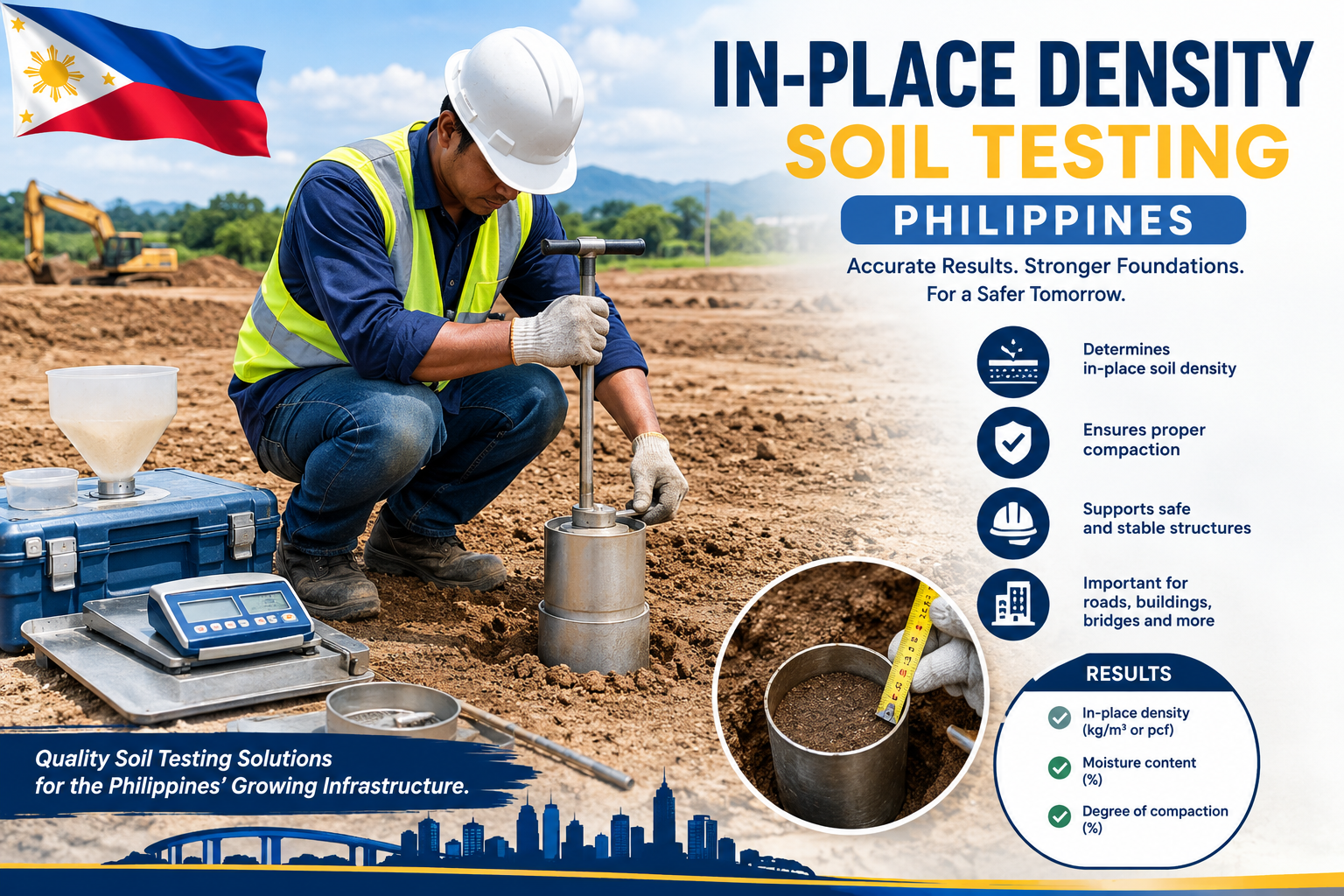
In-place density soil Philippines testing is an important part of construction quality control because it measures the density of soil under actual field conditions. Unlike laboratory testing, which evaluates prepared soil samples under controlled conditions, field density testing examines soil where it has been placed, compacted, or naturally deposited. The results can help engineers and construction teams determine whether earthwork has achieved the density required by project specifications. Soil density is closely connected with compaction, moisture content, air voids, and the overall behavior of the material under load. Properly compacted soil can provide a more stable platform for foundations, pavements, roads, slabs, embankments, and other structures. Field density testing can also identify areas where additional compaction may be necessary before construction progresses to another stage. ASTM D6938, for example, describes nuclear methods for measuring in-place density and water content of soil and soil-aggregate and determining dry density.
Why In-Place Density Testing Matters in Construction
Soil may appear firm and stable on the surface while still containing areas with inadequate compaction below or between tested locations. This is why relying only on visual inspection or the number of passes made by compaction equipment may not provide enough information about actual soil conditions. In-place density soil Philippines testing provides measurable data that can be compared with project requirements and laboratory reference values. When compacted soil does not reach the required density, the material may be more susceptible to settlement or deformation when subjected to construction loads and long-term service conditions. Proper testing can help identify potential quality issues before foundations, pavement layers, flooring systems, or other structural elements are placed over the soil. It can also provide documentation that supports construction quality-control procedures. ASTM notes that in-place density testing can be used for quality control and acceptance testing of compacted soil and soil-aggregate mixtures used in construction. For Philippine construction projects, incorporating appropriate field testing into earthwork activities can therefore help project teams make better-informed decisions about soil preparation.
How Soil Compaction Affects In-Place Density
Compaction is the process of mechanically reducing the amount of air between soil particles, generally increasing the soil’s density. Construction crews may use rollers, vibratory compactors, rammers, or other equipment depending on the soil type and project requirements. The amount of compaction that can be achieved depends on several factors, including soil gradation, particle characteristics, moisture content, compaction energy, and lift thickness. Soil that is too dry may resist rearrangement, while excessive water can occupy pore spaces and interfere with effective compaction. Laboratory compaction testing can establish a reference relationship between moisture content and dry density for a particular soil. Field testing can then be used to determine whether the compacted material is achieving the specified performance level. A properly managed compaction process therefore involves more than simply operating equipment over the soil surface. It requires appropriate material preparation, controlled placement, suitable moisture conditions, adequate compaction effort, and verification through testing.
Common Methods for Measuring In-Place Soil Density
Several methods can be used to determine field soil density, and the appropriate method depends on the material, project specifications, site conditions, and applicable testing standards. The sand cone approach determines in-place density by measuring the volume of an excavated test hole and the mass of material removed from that hole. ASTM’s D1556/D1556M standard describes the sand-cone method for determining the density and unit weight of soil in place. Another widely recognized approach is the nuclear density gauge method, which can provide rapid measurements of wet density and water content and allow dry density to be determined. ASTM D6938 describes direct transmission, backscatter, and backscatter/air-gap approaches for nuclear density measurement. Nuclear testing is particularly useful when repeated measurements are required because the procedure can provide nondestructive measurements at a testing location. The sand cone method, by comparison, involves excavation and material handling, making it important to consider whether the soil can maintain a stable test hole. ASTM specifically identifies limitations for sand-cone testing in materials with certain coarse particles, unstable test holes, organic soils, saturated soils, and highly plastic soils.
What Happens During an In-Place Density Soil Test
A field density test begins with selecting an appropriate testing location based on the project’s quality-control plan and the area being evaluated. The testing surface is prepared so that the equipment or testing apparatus can make reliable contact with the soil. For nuclear gauge testing, the gauge may be positioned on the prepared surface, while direct transmission testing uses a probe inserted into a prepared hole to a specified depth. ASTM D6938 describes direct transmission as a procedure in which the source rod extends into a pre-formed hole, while backscatter measurements keep the source and detectors at the surface. Depending on the method, the technician records density, moisture, depth, location, and other relevant information. The resulting measurements can then be evaluated against the applicable project criteria. Proper calibration, equipment suitability, operator competence, and testing procedures are important because the quality of field results depends on these factors. Accurate records also make it easier for engineers, contractors, and quality-control personnel to track testing results across different areas of a project.
Key Measurements in In-Place Density Testing
Understanding the measurements produced by an in-place density soil Philippines test is important for interpreting construction quality data. Wet density represents the mass of soil and its contained water per unit volume. Dry density focuses on the mass of soil solids per unit volume after accounting for the water present in the tested material. Moisture content describes the amount of water relative to the mass of dry soil solids and is an important factor in evaluating compaction. Nuclear testing methods can measure wet density and water content and determine dry density from those measurements. Project teams may then compare field dry density with a laboratory maximum dry density or another specified reference value. The resulting percentage of compaction can be used as a quality-control indicator when the project specification defines the appropriate calculation and acceptance criteria. The required percentage should always come from the applicable plans, specifications, engineering requirements, or governing standards rather than assuming that one percentage applies to every soil or project.
Factors That Can Affect In-Place Density Results
Field density measurements can be influenced by both the soil itself and the conditions under which the test is performed. Soil composition is one important factor because granular, cohesive, mixed, and highly variable materials can behave differently during compaction and measurement. Moisture content can also significantly influence compaction behavior and the density that can be achieved with a given amount of mechanical effort. Surface irregularities, loose particles, voids, large rocks, and an improperly prepared testing location may affect the quality of a measurement. Equipment condition and calibration are equally important because field instruments need to produce reliable and repeatable readings. ASTM D6938 emphasizes that result quality depends on the competence of personnel and the suitability of the equipment and facilities used. Testing conditions should therefore be documented carefully, particularly when results are being used for formal project acceptance. When unexpected results occur, engineers and testing professionals should evaluate the material, moisture, testing procedure, and site conditions before making decisions about the affected area.
Applications of In-Place Density Soil Testing in the Philippines
In-place density soil Philippines testing can be useful across many types of construction and civil engineering work. Road and highway projects may require density verification for compacted subgrade, embankment, base-related materials, or other earthwork layers. Building projects can use field density testing when preparing building pads, backfills, foundation areas, and other portions of a site that require controlled compaction. Parking areas, pavement systems, warehouses, industrial facilities, and commercial developments may also require verification of compacted soil layers. Testing can be relevant to trench backfilling, utility installation, drainage works, and site grading when project specifications require measurable compaction control. Embankments and other earth structures can benefit from systematic testing because variations in compaction may influence performance across the completed earthwork. The exact testing frequency and acceptance criteria should be established by the project engineer, specifications, contract documents, and applicable standards. Using field measurements at appropriate stages can help construction teams detect deficiencies before subsequent layers make the affected soil difficult to access.
How to Interpret In-Place Density Soil Results
A field density report typically contains measurements that help engineers evaluate the condition of the tested material at a specific location. The dry density may be compared with the laboratory maximum dry density or another reference established for the project. A result that meets the specified requirement may indicate that the tested location has achieved the required level of compaction. A result below the requirement may indicate the need for additional compaction, moisture adjustment, retesting, or further technical evaluation. However, a single result should not automatically be treated as representative of an entire construction area. Soil properties can vary significantly from one location to another, particularly on large sites or projects involving imported fill. Test location, elevation, lift, soil type, moisture condition, and compaction equipment should therefore be considered when reviewing results. Accurate field records allow quality-control teams to identify patterns and determine whether additional testing or corrective work is appropriate.
Choosing an In-Place Density Soil Testing Service in the Philippines
Selecting a qualified testing provider is an important consideration when field density results will be used for construction quality control or project acceptance. The provider should have suitable equipment, trained personnel, and procedures appropriate for the test method specified by the project. Clients should ask which testing standards the provider follows and whether the selected method is appropriate for the soil being evaluated. Equipment calibration and routine quality-control procedures are also important because field measurements need to be dependable and repeatable. A professional testing provider should be able to document test locations, measured values, relevant site conditions, and other information required for project records. ASTM D6938 notes that competent personnel and suitable equipment and facilities are important factors affecting test quality. Before testing begins, project teams should also clarify the required reporting format, test frequency, acceptance criteria, and scheduling requirements. Choosing the right testing service can make it easier for contractors, engineers, developers, and project owners to incorporate soil verification into the overall construction quality-control process.
Frequently Asked Questions About In-Place Density Soil Philippines
1. What is in-place density soil testing?
In-place density soil testing measures the density of soil under actual field conditions. It is commonly used to evaluate compacted soil and determine whether the material meets specified project requirements. Depending on the selected procedure, the test may also measure moisture content and determine dry density.
2. Why is in-place density testing important?
Field density testing provides measurable information about the effectiveness of soil compaction. It can help identify areas where soil may require additional work before subsequent construction activities take place. This information is particularly useful for earthwork, foundations, roads, pavements, embankments, and backfills.
3. What methods are used for field density testing?
Common approaches include sand cone testing and nuclear density gauge testing. The sand cone method determines soil volume through an excavated test hole, while nuclear methods can provide rapid measurements of density and moisture. ASTM D6938 describes nuclear methods for measuring in-place density and water content of soil and soil-aggregate.
4. What is the difference between wet density and dry density?
Wet density includes the mass of both soil solids and water within a given volume. Dry density focuses on the mass of soil solids relative to the same volume after accounting for water. Dry density is commonly used when evaluating the degree of soil compaction against a laboratory or project reference.
5. How does moisture content affect soil compaction?
Moisture affects how soil particles move and rearrange during compaction. Soil that is excessively dry may be difficult to compact effectively, while excessive water can also interfere with achieving the desired density. The appropriate moisture condition depends on the characteristics of the soil and the applicable project requirements.
6. What is ASTM D6938?
ASTM D6938 is a standard test method covering in-place density and water-content measurements of soil and soil-aggregate using nuclear methods at shallow depths. The method can be used to obtain wet density and water content and determine dry density. It also provides procedures involving direct transmission and backscatter measurement approaches.
7. When should an in-place density soil test be performed?
Testing is generally performed after a soil layer has been compacted and when verification is required before the next construction stage. The exact timing and frequency depend on project specifications, the construction schedule, and the requirements established by the engineer or quality-control plan. Testing may be repeated when results do not satisfy the specified criteria.
8. Who should perform an in-place density soil test?
Testing should be performed by personnel who are properly trained and competent in the selected testing procedure. Suitable equipment, appropriate calibration, proper site preparation, and accurate documentation are also essential. ASTM specifically recognizes personnel competence and equipment suitability as factors affecting the quality of test results.
Takeaway: Building Confidence Through Reliable Soil Density Testing
Reliable soil testing provides construction teams with measurable information that visual inspection alone cannot provide. In-place density soil Philippines testing can help verify whether compacted soil has reached the density required for a particular construction application. Different testing methods are available, and the appropriate option depends on soil characteristics, project requirements, applicable standards, and site conditions. Field density measurements can support quality control for roads, foundations, building pads, pavements, embankments, backfills, and other earthwork applications. Accurate results depend on appropriate equipment, competent personnel, suitable testing procedures, and careful documentation. When field results indicate insufficient compaction, corrective measures can be evaluated before the next construction stage covers the affected area. Making soil density verification part of a well-planned quality-control process can help project teams achieve more consistent earthwork performance and greater confidence in the completed construction.