Stable ground supports every successful building, road, bridge, warehouse, and development project. Soil may look firm at surface level, yet hidden layers can contain loose material, excessive moisture, soft clay, poor grading, or other conditions that affect structural performance. Professional Soil Testing gives engineers, contractors, architects, developers, and property owners dependable data before major work begins.
Soil Testing measures key ground properties linked to bearing capacity, settlement potential, particle distribution, plasticity, moisture response, density, and overall suitability for construction. Clear results help project teams choose proper foundation systems, plan excavation, assess subgrade quality, and reduce costly surprises. Inch-On Materials Laboratory supports these decisions through recognized test methods, calibrated equipment, organized reporting, and technical service focused on dependable project data.
What Is Soil Testing?
Soil Testing refers to field and laboratory procedures used to measure physical and engineering properties of soil. These procedures help classify ground materials and determine how they may respond to structural loads, water exposure, compaction, excavation, or long-term use.
A single site can contain several soil layers with very different characteristics. Upper layers may consist of loose fill, while deeper layers may contain clay, sand, gravel, or weathered rock. Soil Testing helps reveal these differences so design teams can base decisions on measured conditions rather than appearance or assumption.
Results may support foundation selection, pavement planning, drainage design, earthwork control, fill assessment, site grading, and ground improvement. Each project has unique requirements, so selected test methods should match structural needs, site conditions, and project specifications.
Why Soil Testing Matters Before Construction
Soil Testing can prevent major technical and financial problems. A structure transfers weight toward the ground through footings, slabs, piles, or other foundation components. Should soil lack enough strength, excessive movement may occur. Cracks, uneven floors, tilted walls, pavement failure, or drainage issues may follow.
Early Soil Testing helps identify weak layers, compressible materials, high-plasticity clay, loose sand, unsuitable fill, and moisture-sensitive soil. Such findings allow engineers to recommend excavation depth, replacement materials, compaction targets, footing dimensions, pile requirements, or soil treatment methods before construction advances.
Accurate soil data also helps control budget decisions. Without testing, project teams may overdesign foundations, underestimate earthwork, order unsuitable materials, or face redesign after excavation. Soil Testing supports better cost planning by reducing uncertainty and helping teams address ground concerns before they become larger problems.
Soil Bearing Capacity and Structural Support
Bearing capacity describes how much load soil can support without shear failure or unacceptable movement. Buildings, bridges, retaining walls, and heavy facilities place different demands on underlying ground. Soil Testing helps assess whether site materials can support expected loads.
Weak or loose soil may require larger footings, deeper foundations, replacement fill, compaction, or other corrective measures. Stronger and more stable soil may support a simpler foundation approach, subject to engineering review. Proper Soil Testing gives designers data needed to compare available options and select a practical foundation system.
Bearing capacity should never be judged by surface appearance alone. Dry crust may cover soft material, while compact-looking soil may lose strength after water exposure. Field and laboratory measurements provide a more dependable basis for structural planning.
Soil Testing and Settlement Risk
Settlement happens when soil compresses after load placement. Some settlement may be expected, but excessive or uneven movement can damage structural elements. Differential settlement, where one area moves more than another, may cause wall cracks, misaligned doors, sloping floors, damaged utilities, or foundation distress.
Soil Testing helps identify compressible layers and variable ground conditions that may produce unequal movement. Clay content, moisture level, density, particle grading, and past fill placement can affect settlement behavior. Results give engineers a clearer basis for foundation depth, ground preparation, preload measures, or other recommendations.
Projects built over uncontrolled fill, reclaimed land, soft clay, or mixed soil deposits often require careful assessment. Soil Testing supports safer choices by showing where additional investigation or treatment may be needed.
Key Soil Properties Checked Through Soil Testing
Soil Testing may assess several properties depending on project scope. Particle-size distribution shows relative amounts of gravel, sand, silt, and clay. Such proportions affect drainage, compaction, strength, and response to water.
Plasticity measures how fine-grained soil changes as moisture rises or falls. Highly plastic clay may shrink during dry periods and swell after wet conditions. Such movement can affect slabs, pavements, footings, and buried utilities.
Moisture content affects compaction and strength. Soil that is too wet may be difficult to compact, while soil that is too dry may also fail to reach target density without moisture adjustment. Density measurements help confirm how tightly soil particles are packed.
Consistency and penetration resistance provide added information about ground strength. Together, these values help engineers classify soil, compare layers, and judge construction suitability.
ASTM D1586 Standard Penetration Test
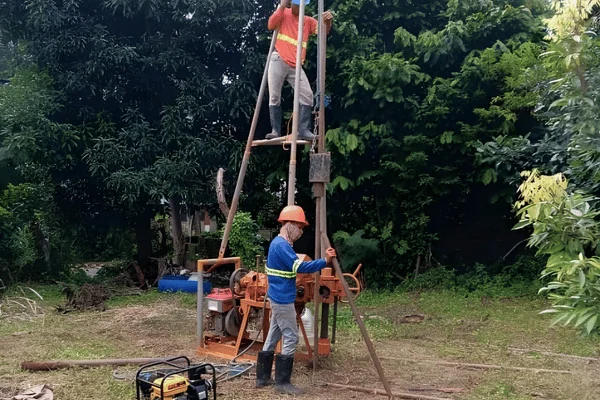
ASTM D1586 covers the Standard Penetration Test, commonly called SPT. This field procedure measures resistance as a sampler is driven through soil. Blow counts give a practical indication of relative density or consistency across subsurface layers.
SPT data may support foundation evaluation, soil profile development, settlement review, and geotechnical design. Loose sand, soft clay, dense material, or changing layers can produce different resistance values. Engineers review these measurements together with sample descriptions, groundwater observations, and other project data.
Soil Testing through ASTM D1586 can serve projects such as residential buildings, commercial facilities, roads, bridges, warehouses, and heavy civil works. Proper execution and careful documentation are essential because reliable interpretation depends on accurate field records.
ASTM D4318 Atterberg Limits Testing
ASTM D4318 covers liquid limit, plastic limit, and plasticity index testing for fine-grained soil. These values describe how soil consistency changes with moisture.
Liquid limit marks the moisture condition where soil shifts toward a liquid-like state. Plastic limit marks the point where soil begins losing plastic behavior. Plasticity index represents the moisture range where soil remains plastic.
These measurements help classify clay and silt while also showing potential sensitivity to water. High-plasticity soil may experience larger volume changes, reduced workability, and greater movement risk. Soil Testing through ASTM D4318 helps project teams assess whether site material may require moisture control, replacement, stabilization, or special foundation consideration.
Clear plasticity results are valuable for road subgrades, embankments, building pads, structural fill, and foundation planning. Such data supports material approval and helps prevent use of soil that may perform poorly after seasonal moisture changes.
ASTM D422 Particle-Size Analysis
ASTM D422 covers particle-size analysis used to determine proportions of gravel, sand, silt, and clay where that method is required by project specifications. Sieve procedures separate larger particles, while sedimentation methods assess finer materials.
Particle distribution affects drainage, compaction, permeability, and strength. Well-graded soil contains a broad range of particle sizes that may pack together effectively. Poorly graded soil may contain mostly similar particle sizes, which can affect stability or drainage behavior.
Soil Testing through particle-size analysis helps classify soil and assess its possible use for fill, subgrade, bedding, backfill, embankment, or other construction purposes. Reliable measurements also support comparison against material specifications and engineering requirements.
How the Soil Testing Process Works
A proper Soil Testing program starts with project review. The laboratory or geotechnical team studies structure type, expected loads, site dimensions, planned earthwork, and project requirements. This review helps determine suitable field and laboratory procedures.
Sample collection follows. Representative sampling is essential because test results should reflect actual site materials. Samples need correct labeling, protection, and handling to reduce contamination, moisture loss, or mix-ups.
Laboratory evaluation uses controlled procedures and calibrated equipment. Technicians measure selected properties, record observations, and check results against test requirements. Quality control helps reduce errors and supports repeatable data.
Report preparation comes next. A useful report presents test methods, sample details, measured values, tables, remarks, and relevant observations. Clear reporting helps engineers and contractors apply data to real project decisions.
Soil Testing for Residential Projects
Homes, apartments, townhouses, and residential communities benefit from Soil Testing before foundation work. Even smaller structures can experience cracking or uneven movement when built over weak, expansive, loose, or poorly compacted ground.
Soil Testing helps identify whether shallow footings may be suitable or whether deeper support, replacement fill, compaction, or added ground preparation may be required. Test data may also support drainage planning and slab preparation.
Residential developers can use soil results to reduce repeated repairs across multiple units. Property owners gain added confidence that foundation decisions are based on measured site conditions.
Soil Testing for Commercial and Industrial Projects
Commercial buildings, factories, warehouses, offices, and shopping facilities often carry heavier loads than small residential structures. Floor slabs may support equipment, storage racks, vehicles, or production systems. Soil Testing helps assess whether subgrade and foundation materials can support these demands.
Industrial projects may also involve large paved areas, loading bays, tanks, retaining structures, or utility corridors. Different areas may require different soil performance. Laboratory and field data can guide compaction targets, material selection, excavation, and foundation design.
Reliable Soil Testing supports project coordination among owners, consultants, contractors, and quality-control teams. Clear records also help document compliance with project specifications.
Soil Testing for Roads and Pavements
Road performance depends heavily on subgrade quality. Weak, wet, poorly compacted, or highly plastic soil can contribute to rutting, cracking, depressions, and premature pavement failure.
Soil Testing helps classify subgrade materials and assess moisture response, particle distribution, consistency, and compaction behavior. Such results can guide removal of unsuitable material, placement of selected fill, stabilization, drainage improvements, or pavement design adjustments.
Testing before paving can reduce reconstruction costs later. A strong pavement surface cannot fully compensate for unstable support below. Proper Soil Testing gives road teams valuable data before base and surface layers are placed.
Soil Testing for Bridges and Heavy Civil Works
Bridges, retaining walls, towers, ports, and other heavy civil structures place substantial loads on foundations. Subsurface conditions may vary sharply across short distances, especially near waterways, slopes, reclaimed areas, or filled ground.
Soil Testing helps map changes across soil layers and supports decisions about piles, footings, ground treatment, excavation, and settlement control. SPT results, particle-size data, and plasticity values each contribute useful information for geotechnical review.
Heavy projects usually require close coordination between field teams, laboratories, designers, and contractors. Accurate test records help each party work from the same technical basis.
Common Problems Soil Testing Helps Prevent
Soil Testing helps reduce risk related to excessive settlement, cracked slabs, tilted walls, pavement breakup, drainage failure, erosion, unstable excavations, and weak structural support.
Testing may also reveal unsuitable fill, organic material, high moisture, loose layers, or soil with poor grading. Early discovery allows corrective work before major structural activities proceed.
Without proper data, teams may face project delays, extra hauling, unplanned excavation, foundation redesign, material rejection, or later repair costs. Soil Testing supports earlier decisions and more predictable project execution.
Why Choose Inch-On Materials Laboratory for Soil Testing?
Inch-On Materials Laboratory provides construction testing support backed by recognized procedures, calibrated equipment, and organized reporting. The laboratory serves contractors, engineers, developers, project managers, and other construction professionals who need dependable material data.
The company follows applicable ASTM methods such as ASTM D1586, ASTM D4318, and ASTM D422 based on project requirements. Careful test execution supports accurate assessment of penetration resistance, plasticity, and particle-size distribution.
As a DPWH-BRS accredited independent laboratory, Inch-On Materials Laboratory supports quality control for public and private projects. Its technical team prepares clear reports that help project stakeholders review results without unnecessary confusion.
High-precision equipment supports consistent measurements, while calibration practices help reduce avoidable error. Clients also benefit from technical assistance when reviewing soil classifications, test values, and laboratory findings.
Clear Reporting for Better Project Decisions
A Soil Testing report should do more than list numbers. Project teams need results arranged clearly so they can compare samples, review specifications, and identify possible concerns.
Inch-On Materials Laboratory prepares organized reports with relevant sample details, methods, values, and observations. Such reports can support foundation planning, material approval, earthwork control, pavement preparation, and technical documentation.
Actionable reporting also helps reduce communication gaps. Engineers can review measured data, contractors can plan site work, and project owners can understand why certain ground measures may be required.
Calibrated Equipment and Quality Control
Soil Testing accuracy depends on proper equipment, trained personnel, controlled procedures, and careful recordkeeping. Calibrated devices help reduce measurement variation during particle-size analysis, plasticity testing, and related laboratory work.
Quality control may include equipment checks, sample verification, procedural review, and result confirmation. These steps support dependable data and help protect project decisions from avoidable testing errors.
Inch-On Materials Laboratory places strong emphasis on precision because small measurement differences may affect soil classification or acceptance. Consistent laboratory practice supports stronger confidence across every report.
When Should Soil Testing Be Conducted?
Soil Testing should be considered before foundation design, excavation, road subgrade preparation, structural fill placement, site grading, or major land development.
Testing is also useful before property purchase for large projects, especially where prior site use or fill history is uncertain. Existing structures showing cracks, settlement, or ground movement may also require soil assessment as part of a broader engineering review.
Project teams should avoid waiting until serious ground problems appear. Early Soil Testing gives designers more options and allows corrective work to be planned before schedules become difficult to change.
How Soil Testing Supports Foundation Planning
Foundation design should match structural loads and ground conditions. Soil Testing helps engineers compare shallow footing, mat foundation, pile, or ground-improvement options.
Results may support decisions about footing size, founding depth, allowable bearing values, settlement control, excavation, replacement fill, and compaction. Soil data does not replace qualified engineering judgment, but it provides essential measurements that guide that judgment.
Accurate testing may also prevent unnecessary overdesign. Where soil conditions are favorable, measured data can support practical and cost-aware solutions. Where conditions are poor, Soil Testing helps identify problems early enough for proper treatment.
Choosing a Reliable Soil Testing Laboratory
A dependable Soil Testing laboratory should have suitable accreditation, qualified personnel, recognized procedures, calibrated equipment, and clear reporting practices.
Clients should confirm which test methods apply to their project and ask how samples will be handled. Turnaround, documentation, communication, and technical support also matter because test results often affect active construction schedules.
Inch-On Materials Laboratory offers Soil Testing support for residential, commercial, industrial, road, bridge, government, and private development projects. Its service approach focuses on accurate measurements, practical reporting, and dependable coordination.
Soil Testing as a Practical Project Investment
Soil Testing is a practical step that protects safety, quality, schedule, and budget. Ground problems can be expensive once structural work begins, but early testing gives project teams a chance to respond before costs grow.
Accurate results support safer foundation choices, better earthwork planning, stronger pavement preparation, and clearer material decisions. Soil Testing also creates a documented basis for engineering review and project quality control.
By working with Inch-On Materials Laboratory, clients gain access to recognized testing procedures, calibrated equipment, clear reports, and technical support. That combination helps construction teams build from dependable ground data rather than assumptions.
Frequently Asked Questions About Soil Testing
What is the main purpose of Soil Testing?
Soil Testing measures properties such as strength, particle distribution, plasticity, density, moisture behavior, and resistance. Results help classify soil and support foundation, pavement, earthwork, and site-development decisions.
Is Soil Testing needed before building a house?
Many residential projects benefit from Soil Testing because soil conditions can affect footing design, slab support, settlement, and drainage. Local requirements and project complexity may determine the exact testing scope.
How long does Soil Testing take?
Turnaround depends on sample quantity, selected methods, site access, laboratory workload, and reporting needs. Project teams should discuss schedule requirements before sample collection.
What does ASTM D1586 measure?
ASTM D1586 covers the Standard Penetration Test. The procedure records resistance as a sampler is driven through soil, helping assess subsurface density or consistency.
What does ASTM D4318 measure?
ASTM D4318 covers liquid limit, plastic limit, and plasticity index. These values describe moisture-related consistency changes for fine-grained soil.
What does ASTM D422 measure?
ASTM D422 covers particle-size analysis where specified. The method determines proportions of gravel, sand, silt, and clay.
Can Soil Testing help reduce foundation costs?
Yes. Accurate soil data may prevent unnecessary overdesign, reduce redesign risk, support suitable foundation selection, and identify weak ground before major construction expenses occur.
Who reviews Soil Testing results?
Civil engineers, geotechnical engineers, structural engineers, architects, contractors, developers, and project owners may review results depending on project scope.
Why choose Inch-On Materials Laboratory for Soil Testing?
Inch-On Materials Laboratory offers ASTM-based procedures, calibrated equipment, organized reports, technical assistance, and DPWH-BRS accredited testing support for varied construction projects.
When should a project team request Soil Testing?
Testing should be planned before foundation design, excavation, fill placement, pavement preparation, or major earthwork. Early scheduling gives project teams more time to address unsuitable ground conditions.